
You’ve spent weeks—maybe months—perfecting your research. The data’s solid, your findings are significant, and you’re genuinely excited about what you’ve discovered. Then comes the poster presentation, and suddenly you’re standing in front of a 4-foot-wide display wondering if anyone will actually stop to look. That flutter of anxiety is completely normal. Academic poster presentations represent a unique challenge: you need to condense complex research into a visually compelling display that captures attention within seconds, whilst simultaneously demonstrating expertise to judges who’ll spend perhaps three minutes at your poster before moving on.
What Are Judges Actually Looking for in a Poster Presentation?
Understanding the judging criteria is your strategic advantage. Across universities in Australia, the UK, and internationally, poster judging consistently breaks down into three weighted categories, though the specific point allocations vary by institution.
The most common framework allocates:
- Display/Design: 20 points maximum
- Content: 20 points maximum
- Oral Presentation: 10 points maximum
Some institutions use an alternative structure weighting content at 40%, display at 30%, and oral presentation at 20%, with 10% for the abstract. Regardless of the specific breakdown, the underlying principles remain remarkably consistent: judges evaluate whether your poster communicates clearly from a distance, whether your research demonstrates rigorous methodology and sound conclusions, and whether you can articulate your work with genuine enthusiasm and comprehensive knowledge.
Here’s what judges won’t tell you directly: they’re not expecting perfection. They’re looking for posters that make sense to a general educated audience, where someone unfamiliar with your specific research area can grasp the fundamental question, approach, and significance within their brief visit. The best posters balance visual impact with intellectual substance, creating what one university guide describes as “1,000+ words equivalent in communicative value” through strategic graphics use.
| Judging Category | Typical Weight | Key Evaluation Points |
|---|---|---|
| Display & Design | 20-30% | Readability from distance, logical layout, visual hierarchy, colour choices, white space usage |
| Content Quality | 40-50% | Clear research question, sound methodology, evidence-based conclusions, appropriate scope |
| Oral Delivery | 20-30% | Clarity of explanation, enthusiasm, audience engagement, comprehensive answers to questions |
| Professional Polish | Throughout | Grammar, spelling, organisation, presenter demeanour, time management |
How Should You Design Your Poster for Maximum Visual Impact?
The brutal truth about poster sessions: judges make initial assessments within the first 10-15 seconds of seeing your poster. If the visual design doesn’t immediately communicate “This is worth my time,” they’ll move on before reading a single word.
Size and readability standards are non-negotiable. Standard poster dimensions typically measure 36 inches wide by 48 inches high (approximately 90cm x 120cm), though some conferences specify 4 feet by 8 feet boards. Your title must be readable from 25-50 feet away, requiring 72-150 point font size in bold. Main body text needs 24-32 point font minimum—anything smaller and you’re forcing judges to squint, which immediately counts against you. Test this by printing a letter-size version and holding it at arm’s length. If you can’t read most text or identify figures clearly, increase your font size immediately.
Colour strategy makes or breaks visual appeal. Limit yourself to 2-3 colours maximum throughout the entire poster, using complementary, monochromatic, or analogous schemes from the colour wheel. Light backgrounds with dark text provide optimal contrast—think white, light grey, or light beige backgrounds rather than trying to be “creative” with neon borders or rainbow effects. Consider that approximately 8% of viewers may have red-green colour blindness, so avoid isoluminous combinations like dark red on navy blue or chartreuse on light grey.
Layout follows natural reading patterns. Organise content in 2-4 columns (depending on poster width) following “reader gravity”—top to bottom, left to right. Number your sections clearly (1, 2, 3…) so the reading sequence is obvious even when you’re not present. Use white space intentionally as visual pauses that organise content into comprehensible segments. An uncluttered design with balanced spacing isn’t wasted space—it’s strategic communication that makes your poster feel professional rather than overwhelming.
The graphics-to-text ratio should approximate 50-70% visuals, 30-50% text. This isn’t just aesthetic preference; it’s cognitive psychology. Your audience processes visual information far more quickly than text blocks. Every figure must include a clear legend or caption adjacent to the image. Charts and graphs should be simple and clean with clearly labelled axes, removing gridlines that add visual clutter. Make sure all images are high-resolution—pixelated or blurry graphics immediately signal poor attention to detail.
What Content Must You Include to Meet Judging Standards?
Academic poster content requirements are more standardised than you might expect. Every poster needs these essential sections: title matching your submitted abstract, your name and institution, a brief abstract or summary, introduction/background, methods/procedures, results, discussion/conclusions, literature references, and acknowledgements. What varies is how effectively you present each section within severe space constraints.
Keep total text to 300-800 words maximum across your entire poster. Yes, you read that correctly—your entire poster should contain roughly what you’d write in a single-page essay. Use bullet points religiously. Short, concise statements of 50-75 words per section work far better than paragraph blocks. Define all jargon and technical terms clearly. Remember: judges often evaluate posters outside their specific research area, so accessibility to a general educated audience is crucial.
Your introduction/background progresses from general topics to your specific research question, answering “Why is this problem important?” Include citations but keep this section equivalent to approximately one double-spaced page if it were written out. The methods section summarises your approach without drowning in messy experimental details—consider using a flow chart to visualise your methodology rather than lengthy text. Skip the complete materials and methods you’d include in a paper; focus on strategic approach.
The results section typically becomes your largest poster area and should be the most prominent visual feature. Don’t present raw data; present analysed, interpreted results. Make this section image-based with minimal words, using figure legends as your explanatory text. Your conclusions/discussion should be brief—2-4 bullet points summarising take-home results, interpreting implications, mentioning alternative explanations for unexpected findings, and comparing conclusions to your original hypothesis.
Literature citations should be concise—typically 5 maximum references in short format. Position text near the relevant figures it describes, aiming for approximately one paragraph per image or image group. Spelling, grammar, and punctuation errors are absolutely unacceptable and will cost you points immediately.
How Do You Deliver an Effective Oral Presentation at Your Poster?
Here’s what separates good posters from prize-winning ones: your oral presentation. You need two prepared presentations—a 2-3 minute “elevator pitch” introducing your topic, findings, and importance, plus a full 5-10 minute detailed presentation for engaged viewers. Practice both until you can deliver them smoothly without hesitation.
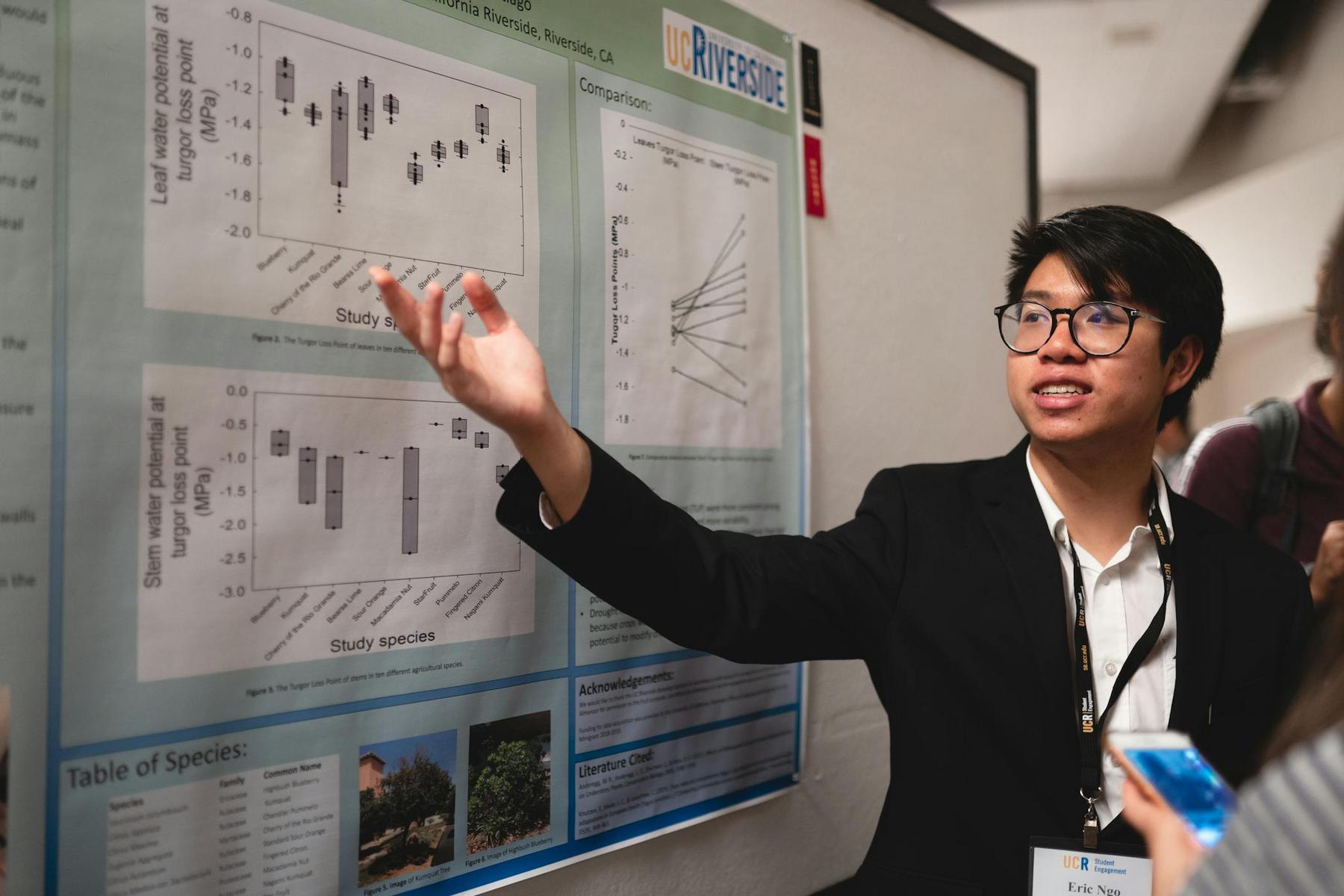
Positioning and body language matter more than you think. Stand to the left of your poster initially (where reading begins). Don’t block your title or key sections. Use your whole hand to gesture toward relevant parts rather than pointing with one finger. Use the arm closest to the poster when gesturing to avoid crossing your body awkwardly. Never turn your back on the audience whilst gesturing. Maintain eye contact throughout, smile genuinely, and avoid defensive postures like crossed arms.
Speaking technique determines engagement levels. Speak clearly and distinctly with appropriate volume for the venue. Use your poster as a visual tool but don’t read directly from it—speak about your work informally and conversationally. Avoid verbal fillers like “um,” “er,” and “you know.” Show genuine enthusiasm about your research even toward the end of a long poster session when fatigue sets in. Pause long enough for viewers to actually look at figures whilst you’re discussing them.
Audience engagement starts before they reach your poster. When someone approaches, take initiative: smile, greet them, shake hands if appropriate, introduce yourself with your year level and university, and ask if they’d like you to walk them through the poster. Crucially, ask if they’re familiar with your field of research so you can gauge the appropriate explanation level. Point to relevant sections as you discuss them, maintaining eye contact with your audience throughout.
Question handling reveals your expertise. Prepare for likely questions in advance. When asked something, take a breath and focus before answering fully and clearly. Ask for clarification if the question is unclear. If someone asks something outside your scope, “I don’t know” is perfectly acceptable—offer to follow up after the session and ask for their contact information. Never make up answers; this destroys credibility instantly. Welcome critical feedback as improvement opportunities rather than becoming defensive.
What Common Mistakes Should You Avoid During Poster Judging?
The difference between average and exceptional posters often comes down to avoiding preventable errors. Understanding what judges consistently mark down helps you sidestep these pitfalls entirely.
Design mistakes kill your poster before content gets evaluated. Overlong titles with excessive jargon or unnecessary colons make judges’ eyes glaze over. Using illegible fonts (looking at you, Comic Sans and Brush Script) or excessive font variety creates visual chaos. Gratuitous colours, neon borders, and rainbow effects scream “amateur.” Text too small to read from appropriate distance means judges simply won’t read it. Cluttered designs with insufficient white space overwhelm viewers. Posters that force readers to jump around non-linearly create confusion and frustration.
Content mistakes reveal poor understanding of the format. Many students treat posters as printed research papers—this fails spectacularly. Don’t lift long text sections directly from manuscripts. Don’t waste space on messy experimental details no one has time to absorb. Don’t display every gel, sequence, or genotype. Including long tables that require minutes to decipher guarantees judges will skip them entirely. Too much technical jargon without definitions alienates non-specialist judges. Results that don’t clearly support conclusions signal weak methodology. Conclusions extending beyond data presented suggest poor scientific reasoning.
Presentation mistakes undermine otherwise solid research. Reading poster text verbatim to your audience makes them wonder why you’re even there. Standing in front of your poster blocking views frustrates judges. Not being present during your poster session is essentially academic self-sabotage. Appearing unprepared or lacking knowledge about your own research raises serious concerns about the work’s validity. Failing to engage with or welcome viewers creates an unwelcoming atmosphere. Defensive reactions to critical questions suggest intellectual insecurity. Making up answers rather than admitting knowledge gaps destroys trust. Lack of enthusiasm signals you don’t value your own work—why should judges?
Why Does Poster Presentation Mastery Matter for Your Academic Career?
Beyond the immediate assessment, poster presentations serve as critical career-building opportunities. Many lifelong professional relationships begin in front of poster boards at conferences. These presentations demonstrate your ability to communicate complex ideas accessibly—a skill valued across academic, research, and industry contexts. Poster prizes legitimately strengthen your CV when peers review applications for postgraduate positions, research roles, and competitive programmes.
Poster sessions also provide invaluable practice in public speaking, teaching, and learning simultaneously. The interactive format allows you to refine your explanations based on immediate feedback, test how different audiences respond to your framing, and identify gaps in your communication strategy. Unlike oral presentations where you deliver once and finish, poster sessions offer hours of iterative improvement as you present to successive viewers.
The poster itself demonstrates expertise and attention to detail, representing both you and your research supervisor at conferences, symposia, and departmental events. A well-executed poster signals that you understand professional academic standards, can distil complex work into core messages, and possess the design literacy increasingly expected in modern research contexts. Conversely, a poorly executed poster—regardless of research quality—raises questions about professionalism and care.
Moreover, poster presentations share your ideas and create collaboration opportunities. Many groundbreaking research partnerships emerge from conversations sparked by compelling posters. Viewers might suggest methodological improvements, relevant literature you’ve missed, or applications you hadn’t considered. These interactions enrich your research and expand your academic network simultaneously.
Bringing It All Together: Your Pre-Submission Checklist
Before submitting your poster for judging, work through this comprehensive checklist methodically. Can someone unfamiliar with your research understand your core question, approach, and findings within three minutes? Is your title readable from 25 feet away? Does your body text use 24-32 point font minimum? Have you limited colours to 2-3 maximum with appropriate contrast? Does your layout follow logical reading patterns with numbered sections? Have you maximised graphics over text blocks, aiming for 50-70% visual content? Are all figures high-resolution with clear legends?
Regarding content: have you kept total text to 300-800 words? Are conclusions evidence-based without extending beyond your data? Have you defined all technical terms? Do you include all required sections (title, name/institution, abstract, introduction, methods, results, discussion, references, acknowledgements)? Is spelling, grammar, and punctuation flawless throughout? Have multiple people reviewed your poster—ideally including someone outside your department who can verify accessibility?
For presentation preparation: have you developed both a 2-3 minute elevator pitch and a full 5-10 minute presentation? Have you practiced extensively, knowing what to say for each figure? Can you answer likely questions comprehensively? Have you prepared handouts or business cards for interested viewers? Do you know what to do if someone asks something outside your expertise?
Print a letter-size version and hold it at arm’s length. If you can’t read most text or clearly identify figures, revise immediately. Show your poster to friends, colleagues, and advisors. Ask them to be brutally honest about clarity, visual appeal, and logical flow. Incorporate their feedback systematically. Remember: revision isn’t admission of weakness—it’s commitment to excellence.
The most successful poster presenters share a common characteristic: they’ve internalised that poster sessions balance scientific rigour with public engagement. Your poster must satisfy both dimensions simultaneously. The visual design attracts viewers initially. The content depth keeps them engaged. Your oral presentation transforms passive viewing into active learning. Master all three dimensions, and you’ll not only meet judging criteria—you’ll exceed them, creating memorable impressions that extend far beyond the poster session itself.
How long should I spend presenting my poster to each judge or viewer?
Plan for 2-3 minutes for your initial elevator pitch with casual viewers, and 5-10 minutes maximum for engaged judges or interested researchers. Most viewers at poster sessions spend 3-5 minutes maximum at each poster, so your presentation must be concise and well-structured. Practice transitioning smoothly between sections and be ready to adjust based on verbal and non-verbal cues.
What should I wear and bring to my poster presentation session?
Dress professionally in business casual to business formal, depending on your conference culture. Wear comfortable shoes, and bring essentials such as pins or thumbtacks, printed mini-posters or business cards, supplementary handouts, a notebook for feedback, water, and any necessary technology. Arriving at least 30 minutes early to set up and mentally prepare is also recommended.
What if a judge asks a question I don’t know how to answer?
It’s perfectly acceptable to say “I don’t know.” Acknowledge the question and offer to follow up with further information after the session. Ask for clarification if needed, and avoid fabricating answers, as honesty and intellectual humility are valued by judges.
How do I handle multiple viewers approaching my poster simultaneously?
Acknowledge new viewers with eye contact and a smile while finishing your current explanation. Politely inform them you’ll be with them shortly, or invite small groups to join the same walkthrough if appropriate. This ensures all viewers feel welcomed without compromising the quality of your presentation.
What’s the difference between a good poster and a prize-winning poster?
Prize-winning posters achieve exceptional visual clarity, address questions of real-world relevance, and are backed by presenters who exude enthusiasm and detailed knowledge. They are the results of multiple review cycles that refine design, content, and delivery, ensuring clarity and engagement from a broad audience.